Acrylic CNC Machining and PEEK CNC Machining: 7 Costly Mistakes to Avoid When Sourcing Custom Parts

Acrylic CNC Machining and PEEK CNC Machining: 7 Costly Mistakes to Avoid When Sourcing Custom Parts
Need custom PEEK or acrylic parts? Learn how Acrylic CNC machining and PEEK CNC machining differ, which specifications affect cost and quality, and what buyers should include in an RFQ.
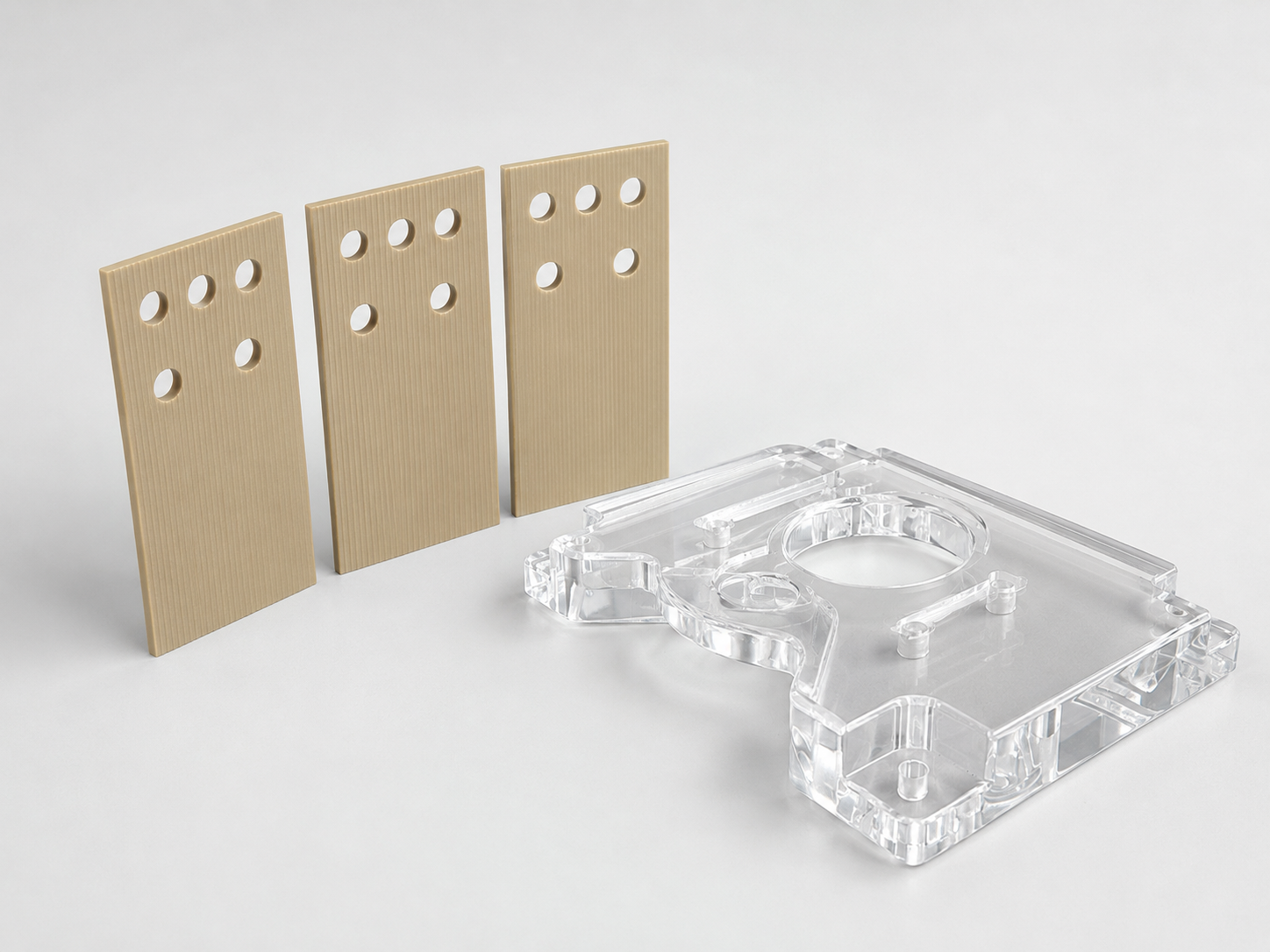
A PEEK manifold arrives with a flatness problem after final machining. An acrylic inspection cover looks perfect when it leaves the machine, but develops fine cracks during assembly. In both cases, the dimensions on the inspection report may appear acceptable, yet the components still fail in use.
These failures often begin before cutting starts. PEEK and acrylic are both engineering plastics, but they respond very differently to heat, cutting forces, workholding, coolant, polishing and internal stress. Treating them like aluminum—or treating them like the same plastic—can produce scrap, delayed validation and expensive repeat orders.
This guide explains the seven mistakes engineers and procurement teams should avoid when sourcing custom plastic parts. It focuses on two commercially important processes: Acrylic CNC machining for clear covers, optical panels, guards and display components; and PEEK CNC machining for high-performance parts used in medical equipment, semiconductor systems, aerospace assemblies and demanding industrial applications.
This article shows what to define in a drawing and RFQ, what a capable CNC machining supplier should evaluate, and how to compare quotations on the same technical basis.
Acrylic CNC Machining vs PEEK CNC Machining: Why the Processes Are Different
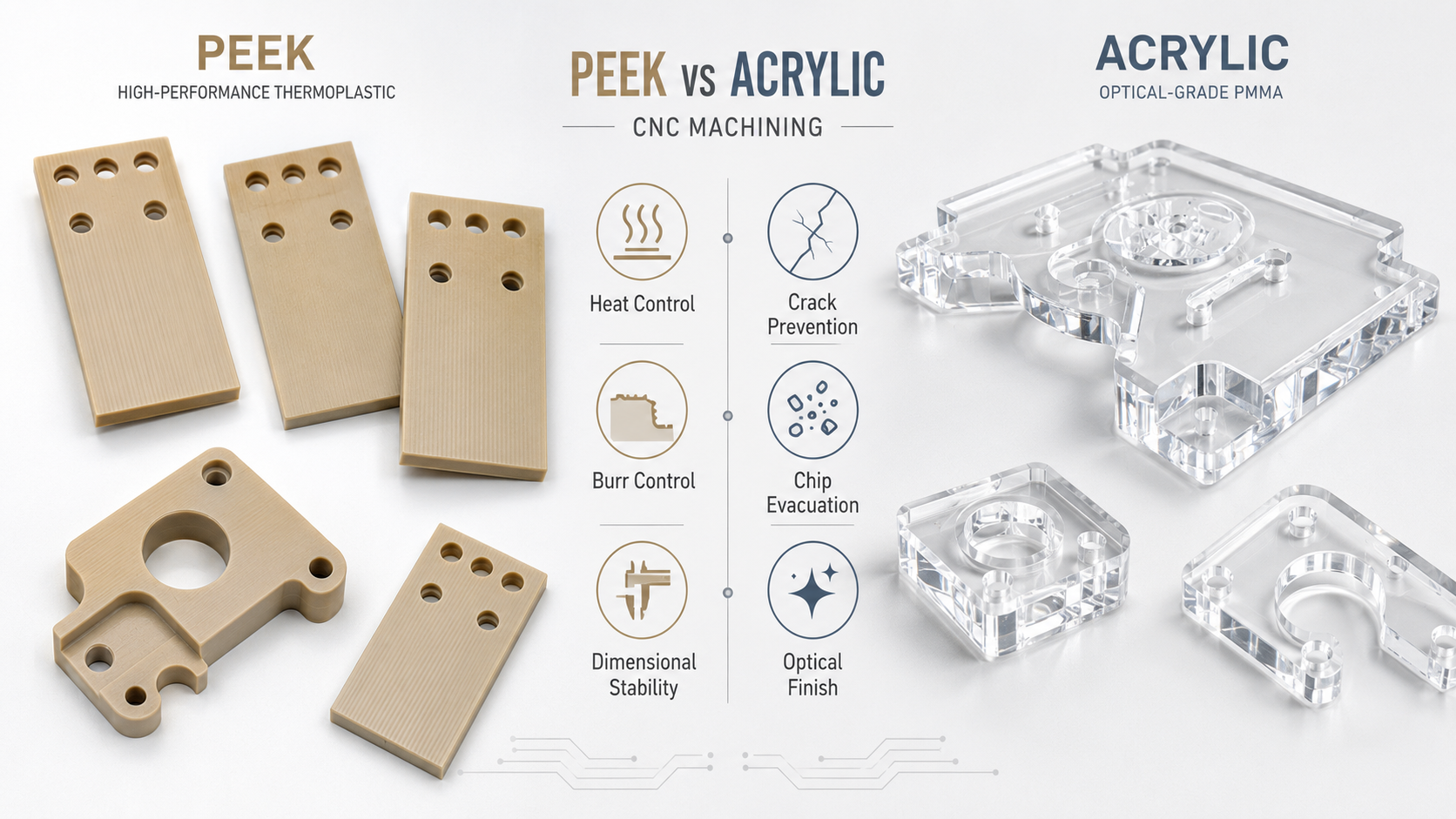
PEEK is a semi-crystalline thermoplastic valued for temperature capability, chemical resistance, wear performance and mechanical strength. It may be supplied unfilled or reinforced with glass fiber, carbon fiber or other additives. Because the material is expensive and frequently used in regulated or technically demanding applications, PEEK CNC machining must control material identity, heat, internal stress, dimensional stability and traceability.
Acrylic, also known as PMMA, is an amorphous and optically clear plastic. It is rigid but comparatively brittle. Acrylic CNC machining therefore focuses on avoiding chipping, melting, crazing, scratches and visible workholding marks. Edge clarity and cosmetic acceptance may be as important as dimensional accuracy.
The purchasing risks are also different. A low PEEK quotation may exclude the specified resin grade, certification, stress-relief sequence or scrap allowance. A low acrylic quotation may assume extruded rather than cast sheet, a standard machined finish instead of a polished optical edge, or ordinary packaging instead of individually protected parts. Buyers should confirm these assumptions before comparing unit prices.
Mistake 1: Specifying Only "PEEK" or "Acrylic" on the Drawing
A material family name is not a complete specification. For PEEK CNC machining, the drawing should identify the exact grade whenever performance or compliance depends on it. Unfilled PEEK, 30% glass-filled PEEK, carbon-filled PEEK, bearing grades and medical grades differ in stiffness, thermal expansion, abrasiveness, appearance and certification. Substituting a generic grade can change both machining behavior and finished-part performance.
Where necessary, state the manufacturer or approved equivalent, filler percentage, color, stock form and certification requirements. If lot traceability or a material certificate is required, include it in the RFQ rather than requesting it after production. A qualified PEEK machining supplier should maintain material identification from incoming stock through final inspection and packaging.
For Acrylic CNC machining, specify whether the stock must be cast or extruded PMMA. Cast acrylic is often selected for demanding machined parts because it generally offers better optical quality and lower residual stress. Extruded acrylic can be economical and suitable for many applications, but it may respond differently during machining, solvent bonding, polishing or chemical exposure.
Also define color, tint, light-transmission needs, UV requirements and whether an approved equivalent is permitted. When a supplier quotes a different stock type, that change should be visible in the quotation. Otherwise, two prices that appear comparable may represent materially different parts.
Mistake 2: Applying Metal Tolerances to CNC-Machined Plastic Parts
Engineers sometimes copy a metal component and apply the same tolerances to a plastic replacement. That approach can add machining time, special fixtures, intermediate inspections and scrap without improving the assembly. Plastics have lower stiffness, higher thermal expansion and greater sensitivity to clamping and measurement conditions than metals.
In PEEK CNC machining, thin walls can deflect under cutting pressure and move after the fixture is released. Flat plates, rings, long components and heavily pocketed parts may change shape as balanced outer material is removed. A dimension that measures correctly while constrained may change after stabilization.
In Acrylic CNC machining, very tight tolerances around thin walls, narrow slots or holes close to an edge increase the risk of chipping and cracking. Small internal corner radii require smaller, less rigid tools and longer cycles. Tight cosmetic and dimensional requirements on the same feature may also require additional finishing and inspection.
Identify the dimensions that control fit, sealing, alignment and function. Use functional datums and apply geometric tolerances where they communicate the design intent better than tight plus/minus limits on every dimension. Non-critical dimensions should have realistic tolerances.
The RFQ should also state the inspection temperature and method when thermal movement matters. For flexible features, agree whether measurements are made in a free state or restrained condition. A precision plastic machining supplier should review these details during DFM rather than simply accepting an unrealistic drawing and adding a large risk premium.
Mistake 3: Ignoring Heat, Internal Stress and Machining Sequence
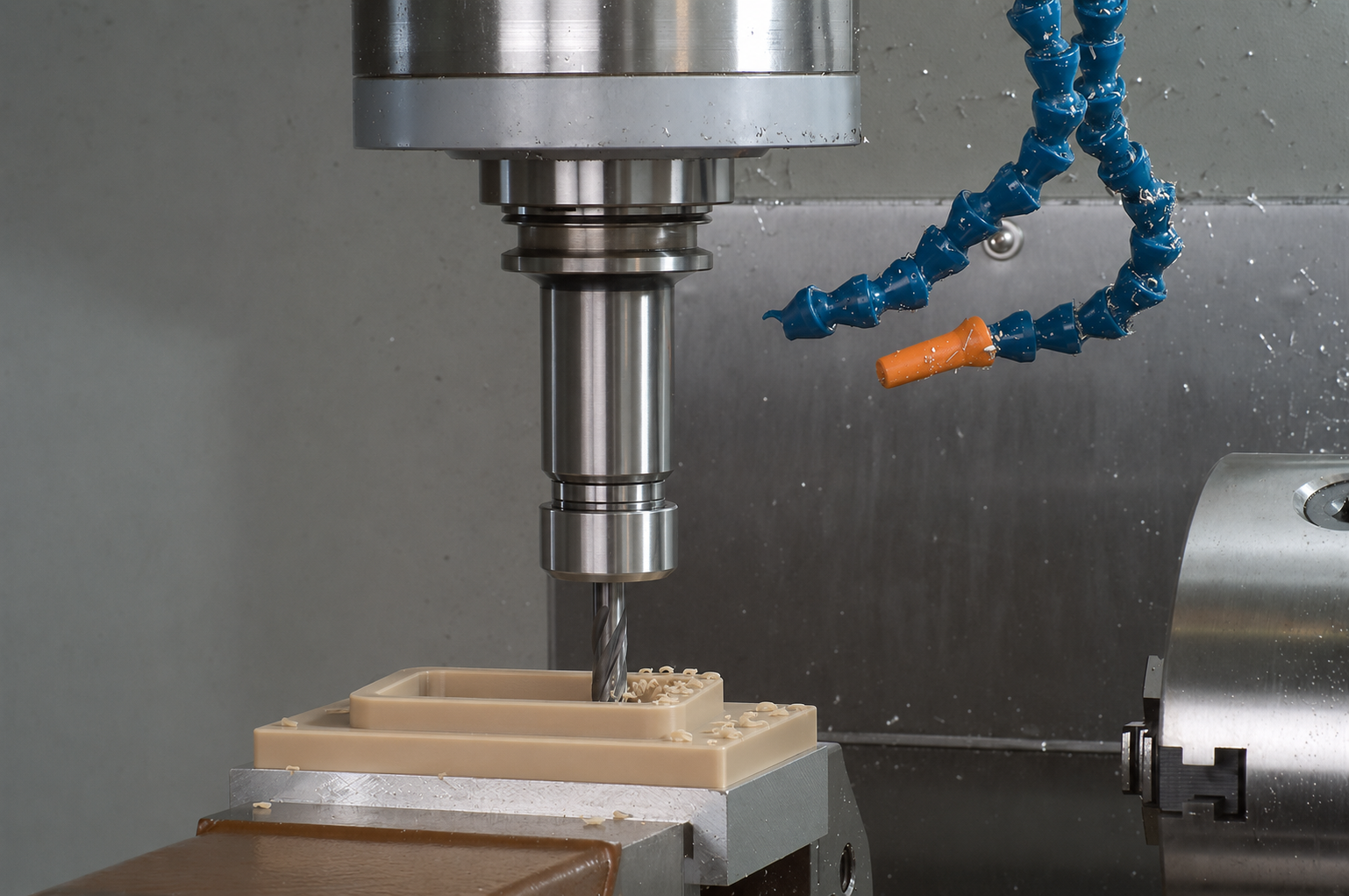
Heat does not leave a plastic workpiece as readily as it leaves aluminum. Dull tools and excessive rubbing can concentrate heat at the cutting edge, producing burrs, smeared surfaces, dimensional drift or local melting. Effective chip evacuation is therefore part of thermal control.
For PEEK CNC machining, the machining sequence is especially important when a high percentage of the original stock is removed. Balanced roughing from opposing faces, controlled finishing allowance and a stabilization period can reduce movement. Depending on the grade, stock condition, geometry and tolerance, an intermediate stress-relief cycle may be appropriate. This is not a rule that every PEEK component must be annealed several times; it is a process decision that should follow the actual risk.
Sharp tools, suitable rake geometry, controlled engagement and limited dwelling help heat leave with the chip. Reinforced PEEK is more abrasive than unfilled material, so tool wear must be managed across the production quantity. A process that holds tolerance on the first components may gradually drift as the cutting edge wears.
During Acrylic CNC machining, local overheating can turn a clear edge cloudy, cause chips to weld back to the surface or create a smeared finish. Stable feed, appropriate spindle speed, sharp polished cutting edges and continuous chip removal help maintain a clean cut. Simply adding coolant is not always safe. Acrylic under residual stress can craze when exposed to an incompatible coolant, cleaner or solvent.
Tell the supplier if the acrylic part will later be bonded, painted, coated or polished. Downstream exposure can reveal stress that was not visible at final machining inspection. For many parts, clean compressed air is preferable to an unverified liquid, but the decision must account for the material grade, equipment, cleanliness requirement and application.
Mistake 4: Using the Wrong Workholding and Support Strategy
Workholding must secure the blank without creating the defect it is intended to prevent. Concentrated clamping force may distort PEEK, mark acrylic or introduce stress that becomes visible only after the part is removed.
PEEK CNC machining often requires support that follows the geometry as material is removed. Soft jaws, machined nests, sacrificial supports or staged fixtures may be needed for thin rings, plates and complex pockets. The supplier should establish datums that remain stable between roughing, finishing and inspection. When multiple setups are required, datum transfer becomes part of the tolerance strategy.
For Acrylic CNC machining, broad soft jaws, protective film, vacuum fixtures, sacrificial backing and custom nests can distribute pressure and protect visible surfaces. Thin sheet also needs support against vibration. Chatter may damage the edge even when the part remains dimensionally acceptable.
The drawing should identify cosmetic faces and areas where fixture marks are unacceptable. If both sides are visible, say so. If protective film may remain during machining, inspection and shipment, include that preference in the purchase specification. A custom acrylic parts manufacturer cannot infer the viewing direction, acceptable contact areas or assembly-facing surfaces from a 3D model alone.
Mistake 5: Describing the Acrylic Requirement Only as "Clear"
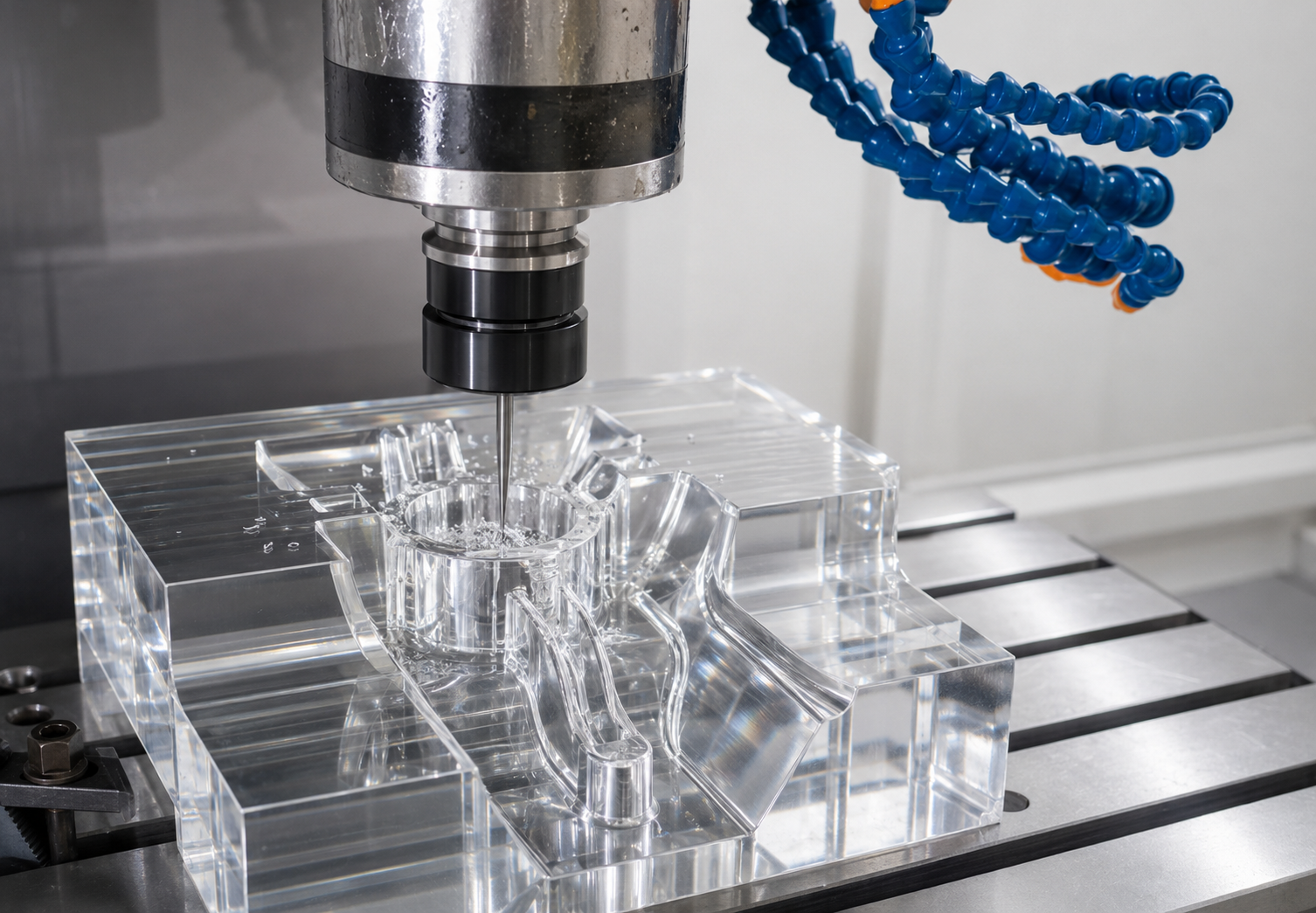
"Clear" is not a measurable finish specification. A machined acrylic component can have several acceptable outcomes: a functional machined edge with visible tool marks, a fine-machined edge for an industrial guard, a polished edge for a display component, or a controlled optical surface with defined haze and scratch limits.
In Acrylic CNC machining, finish selection affects tooling, cycle time, secondary operations, handling and price. Mechanical polishing may improve an edge but adds labor. Flame polishing can produce a clear appearance quickly, but it introduces heat and may increase residual stress. It is not automatically suitable for tight-fitting features, bonded joints, precision sealing surfaces or parts exposed to certain chemicals.
Specify which faces are cosmetic, which edges are directly viewed, and the lighting and viewing distance used for acceptance. Define whether fine tool marks, edge breaks, minor haze or a particular scratch-dig standard are acceptable. If an optical function is critical, provide a measurable optical requirement rather than relying on photographs or the word "transparent."
Packaging belongs in the same specification. Acrylic parts can leave the machine acceptable and arrive scratched because components touched each other in transit. Individual separation, non-abrasive cleaning, retained masking and suitable protective packaging should be included in the quotation when appearance matters.
Mistake 6: Comparing Quotations That Do Not Include the Same Scope
The lowest line-item price is not always the lowest delivered cost. Before selecting a supplier, procurement should make the technical basis of every quotation visible.
For PEEK CNC machining, compare the exact grade and manufacturer, certification, lot traceability, material utilization, roughing and finishing sequence, stress relief, inspection scope and scrap assumptions. PEEK stock can represent a large share of the part cost. A quotation based on uncertified remnants or a substitute grade is not comparable with one based on documented, full-size certified stock.
For Acrylic CNC machining, compare cast versus extruded material, thickness tolerance, optical or cosmetic finish, polishing method, protective handling, cleaning and packaging. Confirm whether the quotation includes removing protective film, restoring it, or supplying each part in an individual sleeve.
For both materials, review first-article inspection, CMM reporting, material certificates, special gauges, surface-finish acceptance and revision level. Confirm quantities, annual demand, delivery destination and whether freight is included. If the supplier recommends a deviation, require it to be written into the quotation.
A useful purchasing comparison includes the cost of rework, replacement freight, line interruption and another validation cycle. Paying slightly more for a controlled process can be less expensive than discovering an unstated assumption after assembly begins.
Mistake 7: Choosing a Supplier Without Relevant Plastic-Machining Controls
A machine shop that produces accurate metal parts does not automatically have the right process for engineering plastics. The equipment may be capable, but success also depends on material handling, sharp tooling, low-stress workholding, thermal control, burr management, cleaning, inspection and packaging.
When evaluating a PEEK machining supplier, ask how the company verifies the incoming material, preserves lot identity, plans heavy material removal and controls reinforced-grade tool wear. For demanding parts, ask what conditions trigger stress relief or intermediate inspection. The supplier should be able to explain the process in relation to your geometry rather than repeat a universal recipe.
When evaluating an acrylic machining supplier, ask how cosmetic faces are protected, how thin sections are supported, how coolant compatibility is assessed and how polished or optical edges are accepted. Request representative parts or photographs where confidentiality allows, but do not use appearance alone as proof of dimensional capability.
Quality systems also matter. An ISO 9001:2015 quality system provides a framework for document control, inspection records and corrective action, although certification alone does not replace process knowledge. Review the supplier's equipment, inspection capability, communication speed and willingness to flag design risk before production.
Bright Rapid supports custom CNC plastic parts from prototype validation through low-volume and repeat production. Our capabilities include 3-axis, 4-axis and 5-axis CNC milling, CNC turning, turn-milling, EDM and coordinated secondary finishing. Material and dimensional inspection are managed under our ISO 9001:2015 quality system, with CMM and other appropriate measuring equipment selected according to the part. Every project is reviewed against its actual geometry, tolerance, material grade and end-use requirements.
Design Guidelines for PEEK CNC Machining
Good design reduces process risk before quotation. Use practical internal corner radii so the supplier can choose a rigid tool. Avoid unnecessary deep, narrow pockets that restrict chip evacuation and require long-reach cutters. Provide enough wall thickness for the geometry and stock size, especially where large volumes of material are removed asymmetrically.
Separate critical interfaces from general surfaces. Define flatness, position and perpendicularity from functional datums. If a sealing face, bearing surface or valve feature is important, identify it clearly. State burr and edge-break requirements, because a perfectly sharp edge may be impractical or unsafe.
For reinforced PEEK, consider whether exposed fibers on a machined surface affect sealing, wear or appearance. Specify surface finish only where it contributes to function. If sterilization, vacuum exposure, chemical contact or high temperature is involved, include those conditions so the material grade, cleaning method and documentation can be reviewed.
PEEK CNC machining is often selected for complex, low-volume precision parts. That makes early DFM particularly valuable: a small change to wall thickness, corner radius, datum scheme or stock size may reduce movement, tool wear and material loss without changing the component's purpose.
Design Guidelines for Acrylic CNC Machining
Acrylic designs should avoid unnecessary stress concentrators. Use realistic internal radii, keep holes a practical distance from edges and provide support for thin sections. Very narrow slots and sharp-bottom pockets increase tool deflection, heat and breakout risk.
Identify visible faces and edges directly on the drawing. Define whether the part is an optical cover, display window, machine guard, light guide, inspection panel or non-cosmetic structural component. Each use can justify a different surface and edge standard.
If the part will be bonded, define the bonding surfaces and joining process. If it will contact alcohol, cleaning agents, oils or other chemicals, list them. Residual stress combined with incompatible chemicals can cause crazing after delivery even when the machined part initially looks acceptable.
Specify allowable chamfers and edge breaks. A tiny controlled edge break can reduce chipping and handling damage, while an undefined "sharp edge" can create disagreement at inspection. For large clear panels, include flatness, mounting strategy and service temperature so the supplier can review both machining and assembly risk.
What to Include in an RFQ for Custom CNC Plastic Parts
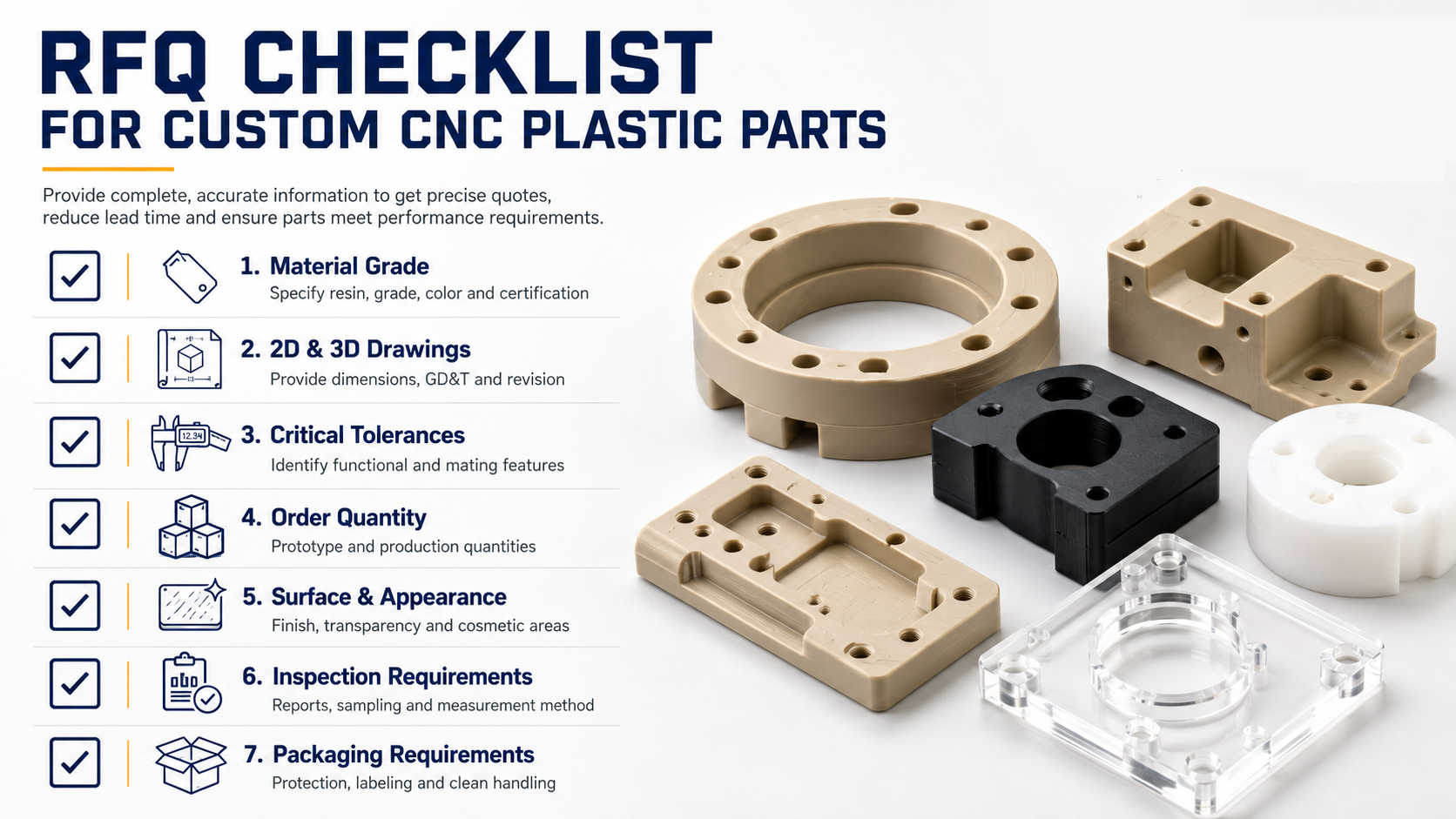
To obtain accurate and comparable quotations, provide the following information:
• Matching 2D drawings and 3D models with revision numbers.
• Exact material grade, manufacturer requirement, filler content, color and stock form.
• Cast or extruded acrylic requirement where applicable.
• Approved-equivalent rules and required material certificates.
• Order quantity, prototype quantity, annual demand and expected repeat frequency.
• Critical dimensions, functional datums, geometric tolerances and measurement conditions.
• Cosmetic zones, optical expectations, scratch limits and required edge finish.
• Burr, chamfer and edge-break acceptance.
• Downstream bonding, polishing, coating, sterilization or chemical exposure.
• Cleaning, residue, protective film and packaging requirements.
• First-article, CMM or inspection-report requirements.
• Delivery location and target schedule.
When confidentiality permits, explain the application. Knowing that a PEEK part is a medical instrument component or semiconductor fixture helps the supplier review traceability, cleaning and functional surfaces. Knowing that an acrylic part is a machine guard rather than an optical display prevents unnecessary polishing cost—or prevents an under-specified cosmetic quotation.
Ask the supplier to identify assumptions and exclusions. This makes the quotation easier to compare and gives engineering an opportunity to resolve risk before a purchase order is released.
Frequently Asked Questions
Is PEEK difficult to CNC machine?
PEEK is machinable, but stable results require control of heat, internal stress, workholding, tool condition and inspection. Reinforced grades add abrasion and tool-wear concerns. Geometry and tolerance usually matter more than the simple statement that the material is PEEK.
Does PEEK always need annealing before machining?
No. The decision depends on grade, stock condition, material-removal ratio, geometry and tolerance. For demanding components, staged roughing, stabilization and an appropriate stress-relief cycle may improve dimensional stability. The process should be justified for the specific part.
Can acrylic be CNC machined without cracking?
Yes. Successful Acrylic CNC machining uses sharp tools, stable support, distributed clamping force, controlled heat and a toolpath that protects entry and exit edges. Risk increases around sharp corners, holes near edges, thin unsupported walls and chemically stressed material.
Is cast acrylic better than extruded acrylic for CNC machining?
Cast acrylic is often preferred for demanding cosmetic or optical machined parts because it generally has lower residual stress and good optical quality. Extruded acrylic can still be suitable and economical. The correct choice depends on tolerance, finish, bonding, chemical exposure and end use.
What tolerances can CNC-machined PEEK and acrylic parts achieve?
There is no responsible universal tolerance. Achievable results depend on size, wall thickness, geometry, stock condition, material grade, workholding, temperature and inspection method. Bright Rapid reviews critical tolerances against the actual drawing and can suggest a DFM adjustment where the specification creates unnecessary cost or instability.
Why do quotations for the same PEEK part vary so much?
Differences may come from material grade, certified stock, scrap allowance, stress-relief operations, fixtures, tool wear, inspection reporting and expected yield. Ask every supplier to state its material and process assumptions before comparing prices.
What information is needed to quote acrylic CNC machining?
Provide the 2D drawing, 3D model, quantity, acrylic type, color, critical dimensions, cosmetic surfaces, edge-finish requirement, downstream bonding or polishing, inspection scope and packaging expectations. These details help the supplier quote the finished requirement rather than only the machining cycle.
Buy the Process, Not Just the Material and Machine Time
Acrylic CNC machining and PEEK CNC machining should not be purchased as interchangeable "plastic machining." PEEK projects depend heavily on grade control, material traceability, thermal management, stress management, tooling and dimensional stability. Acrylic projects depend on crack prevention, edge quality, low-stress workholding, surface protection, chemical compatibility and clearly defined cosmetic acceptance.
Engineers can reduce risk by specifying functional tolerances, realistic geometry, exact material and downstream conditions. Procurement can improve comparisons by making sure every supplier quotes the same material, inspection, finishing, documentation and packaging scope. The machining supplier should connect those requirements to a controlled manufacturing plan and communicate concerns before production.
Upload Your Drawings for a PEEK CNC Machining or Acrylic CNC Machining Quote — Response within 24 hours.
If you are sourcing custom PEEK components, machined acrylic parts or other precision CNC plastic parts, Bright Rapid can review your design for machining risk and quotation clarity. Upload your 2D drawing and 3D model for a DFM review and detailed quote based on your actual grade, quantity, tolerance, finish and inspection requirements.